Sunday, March 31, 2019

Post- WWII feelings

This week we discussed how Germany reconstructed their country after World War II. Germany suffered many loses due to the war: around 7 million Germans were killed, many key cities were destroyed due to bombing and their country was being run by foreign powers. This loss and destruction also lead to a loss of German identity and what is means to be "German."The German Nation post-war had feelings of grief, anger, guilt, sadness and frustration. Due to this, Stunde Null occurred on May 8th, 1945. Stunde Null, also known as "Hour Zero", is a term that means new beginnings. After the devastation of the war, the hour zero was meant to be a way to distance Germany from the horrific actions of the Nazi Party and to create a better, brighter future for the country. However, starting over was not so easy. There was economic, social and political strife still in the country. How German's dealt with their new post war reality varied widely.


Image result for berlin post ww2
Berlin post-World War II: The physical destruction due to the war can clearly be seen in this image of two children walking down a street. The street appears filled with rubble. Many cities such as Berlin were destroyed due to the bombings during the war. 

A way for many German's to cope with their new reality was through artistic endeavors. In this week's reading, I was able to learn more about the life and ideology of one of Germany's most famous song-writer's: Wolf Biermann. A central theme in Biermann's songs and poems were about the search of a "Homeland" or Heimat. Post war Germany was not home for him, neither East or West Germany, and his songs show the disappointment and disillusionment with the new version of the country. His music and it's popularity demonstrate that many German's were not content with their new reality. In fact, the idea of Standu Null, was not completely accepted by the whole country. The term "Vergangenheitsbewältigung" or "coping with the past" was preferred by many. Rather than starting over and forgetting everything in the past, many struggled to so seamlessly move on. A film that demonstrates these feelings is "Germany Year Zero" which follows the life of a boy after the war. Although the title alludes to Standu Null, the film shows the feelings of despair and sadness that persisted to plague the country. These feelings were also demonstrated in art and writings, places where all the negative feelings could be expressed. For example, journalist Eagon Kogon wrote in 1947:
The old ways continue, they have not been eliminated; through mistakes, failures, weakness, and all sorts of stupidity on all sides, they are poisoning existence and crippling our thought, our actions, they besmirch our feelings, they overshadow all hope.

Despite attempts by many to start over at hour zero, many did not share the hopefulness of this idea. 

 Das Holderlin-Lied by Wolfgang Biermann: This song by Biermann where he sings: In this country we feel like foreigners, the alienation and sadness with the new Germany is felt. 


As an American currently living in the U.S political climate, I feel like I can relate to the disillusionment felt by many German's. Living under a presidency that promises "America to be Great", it seems that promises and reality are not the same. As in post World War II Germany, these feelings have been expressed by many artists through art, music, poems and literature. A genre that has tackled these issues quiet clearly is rap. Artist's such as Kendrick Lamar, J. Cole, Joey Bada$$ and Childish Gambino share the frustration, anger and disappointment of living in today's America. Additionally, another medium that has been used is comedy. Many comedians have expressed their disappointment in what is currently America, however in a way to make an audience laugh. It is clear through analysis of different mediums, that during and after distressing times, people use art, music and laughter to express their pain and recover.

This is America- Childish Gambino
Land of the Free- Joey Bada$$


John Mulaney: In this bit, Mulaney discussed how confusing it is to have the current presidency. 


Tuesday, March 26, 2019

Returning Home From War

The horrific scenes of war are kept out of the average citizen's view unless through stories, movies or video games. While these provide insight into what war is like, the only ones who know are soldiers themselves. After reading "A Man Outside", which describes the struggle of a man who has returned from war, I couldn't help but think about the stories and media I know that involve soldiers coming home. There is a ton of discussion on this issue and also on the topic providing for veterans in the United Sates. Basically everyone knows at least one movie about a soldier coming home and struggling to find his place again. What makes it so difficult to come back home?

Some soldiers come home physically injured while some only come home with emotional scars, which can be just as bad if not worse. Some come home with horrific injuries that takes away their sense of humanity. "Johnny Got His Gun" is a novel that was based on a true story about a soldier in WW1 that was written in 1938 by Dalton Trumbo and eventually turned into a movie in 1971. The main character, Joe Bonham, loses his arms, legs, and most of his face due to an artillery shell explosion. He awakens in a hospital bed with having the ability to think, but can barely move and can't speak. He will live the rest of his life in this state of living death. He tries to use morse code by moving his head but ultimately nothing happens. He wants to die but cannot even kill himself so he is trapped inside of his own body. This is an extreme case of a soldier coming home with gruesome injuries, but still a reality. This book/film received a jump in popularity after Metallica was inspired by the story, so they wrote the song, "One". They used clips from the 1971 film in their music video for this song that was off of their "...And Justice For All" album in 1988 (See below). I would advise reading the lyrics before watching the video to get a better understanding and it may be difficult to understand James Hetfield (lead singer). 

I think the most impactful lines from the song are the following:

"Fed through the tube that sticks in me
Just like a wartime novelty
Tied to machines that make me be
Cut this life off from me"

I think these lyrics can resonate even with soldiers who haven't experienced an injury like the one in "Johnny Got His Gun". Some come home and feel so disconnected that they do not want to keep living, such as Beckmann in "The Man Outside". They are thanked for their service and are thought of as heroes, but inside they do not feel that way. They come home to their families and do not feel apart of it. Some don't feel like themselves and they don't feel like they belong. They can be looked at as a "wartime novelty" because they are a living collectible from the war. One could say that they were being controlled like toy soldiers on the battlefield and the ones who come home are valuable because they survived the carnage. 

The best way to understand what soldiers go through when they come home is to listen to one describe it themselves. Jonathan Kirk Davis is a Sergeant in the US Marines and served in Operation Iraqi Freedom. In the following article, he gives his perspective on what it is like serving overseas and what it's like to come home. During the seven months the marines are deployed, they are with each other every day and do not have the choice of going home every night.
The constant insecurity and possible threat from being shot or bombs going off create a battle in a soldiers head between what is safe and what is not. Once they come home, Davis describes it like meeting your friends and family for the first time again. He and his family have grown independently, making it difficult to connect the way they used to. The environment overseas creates a soldier that is on edge, angry, and suspicious. The psychological war that happens after the battlefield is one that cannot be simplified, but Sergeant Davis gives us the best explanation he can.
https://www.forbes.com/sites/quora/2012/06/15/how-do-military-veterans-feel-when-they-return-home-from-combat/#49d0c7e33e1e

Through both of these stories, one can see the struggles that exist mentally in a soldiers head after returning home from combat. Mental health plays a very important role for soldiers who are trying to assimilate back into their normal lives at home. Access to mental health professionals is a big problem facing veterans in the United States and needs to be addressed if we want our soldiers to be able to live the lives they once did. Many politicians and people in power address that our veterans are not receiving the care they need, however, many veterans still struggle to find adequate care. Mental health research and care is as good as it ever has been and some of the people who need it most are the ones coming back from war.


By: Mason Perlman

Sources:
https://www.forbes.com/sites/quora/2012/06/15/how-do-military-veterans-feel-when-they-return-home-from-combat/#49d0c7e33e1e
https://www.azlyrics.com/lyrics/metallica/one.html
https://en.wikipedia.org/wiki/Johnny_Got_His_Gun


A Divided City: Post WWII Berlin


In discussing Germany post WWII, it is impossible to overlook what happened to the capital city of Berlin. During the class we briefly looked at a map depicting how Berlin, like the rest of Germany, was split into four sectors: French, British, American, and Soviet. The dividing of the city mimics the division of the rest of the country. Although Berlin was entirely in East Germany, each of the Allied powers got a sector to govern and keep control of until a new, approved government was established.

After the war, there really wasn't much of a city to return to. Due to the bombings from the Allies, large swaths of the city was nothing but rubble. Only about 65% of the original population remained, the rest had either moved to safety or perished in the bombings. The subject of missing people and homes was touched upon in the reading and discussion of The Man Outside by Wolfgang Borchert during the class this past week. The main protagonist, Beckmann, comes home from the POW camp to discover his house in ruins, his dead child among the rubble, and his wife with another man. The loss of not only house but home and the people he loved wrecked him, much like the rest of Germany was stripped of what they loved.


It wasn't just the city that the Allies destroyed. The people themselves were ruined in one way or another. Many lost homes, family, and friends. Others lost their dignity and humanity. While those learning history are focusing on the cleaning up of the soldiers and concentration camps at the end of the war, many ignore what else the Allied soldiers were up to. A mass rape was underway while the Allies were "taking care of" Germany. Because the subject may not be suitable for all readers, those who are interested may read more here: 

https://www.telegraph.co.uk/culture/tvandradio/11576601/The-truth-behind-The-Rape-of-Berlin.html

In the video below, British soldiers are entering Berlin at the end of the war. The footage shows the ruins of city, comparing images of before and after the war. Many pieces of gorgeous architecture were ruined from the bombs. Places of culture and art, destroyed by the fires of war. They may not have been the homes of the people but they were important nonetheless.


While the well-known Berlin wall wasn't started until 1961, the division between East and West Berlin could be felt. While the Allies jointly ran West Berlin, the Soviets ran the East. This created a hotspot of turmoil for the Cold War. With the birth of the Federal Republic of Germany (FRG)(West Germany) and the German Democratic Republic (GDR)(East Germany), the tensions mounted higher. As West Berlin was still in East Germany, the people living in the French, British, and American sectors felt isolated. The 1948 West Berlin blockade and airlift mentioned in class portrays this well. We talked about West Berlin and how the Soviets cut off supplies going into the city, and thus the airlift was created to relieve the citizens of West Berlin. The event just goes to show how the struggle for control between the communist and democratic powers was shown by their use of Germany and its citizens, especially in Berlin. The differences between the Soviets and the other Allies kept Germany divided through the Cold War and long after. The divide lasted until the reunification of Germany in 1990 and the fall of the Berlin Wall in 1991, several decades after the end of WWII.


-Kat Patrick

Sunday, March 24, 2019

The Art (Or Lack There of) of the National Socialist Movement Following WWI

Week7: The Rise of National Socialism
By Eric Kastelic

Art Connection:

Slight Backstory:

Simply putting it, as hyperinflation took over in Germany and the rest of Europe following the Great Depression the German People looked for and found apparent stability in the National Socialist German Workers' Party. Due to his passionate & intense speaking skills and radical ideas Adolf Hitler became the Reich Chancellor of Germany.

Affect on Art:

Image result for Wolfgang Willrich, Bäuerliches Liebespaar (Rural Lovers),1940
Image result for Georg Grosz: After the Theater    
Before 1933
Georg Grosz: After the Theater (1926)                  After 1933
Wolfgang Willrich: Rural Lovers (1940)

These two posts from our class gallery walk perfectly represent the controlling shift that took place following World War One.  Before the war there was a lot of art depicting the suffering of the German people due to the country being crippled by war, a government that was destined to fail, and rampant inflation. The Nazi Party promised to help the county work their way out of despair but greatly limited the expression of the those people who worked toward display the pain and suffering around them. The Nazi party labeled art they did not approve of as Degenerate art or Entartete Kunst in German in an attempt to control the public opinion about it.  

Degenerate Art:


Video Discussing the use of Art as propaganda
https://www.facinghistory.org/resource-library/video/art-propaganda-nazi-degenerate-art-exhibit

During the 1930's most modern art was labeled as ‘degenerate’ by the Nazi party.
Art was purged by German museums via the government.  Over 15,550 works were collected and many were destroyed. Before some were destroyed or taken they were put on display at a Degenerate Art Show that encourage the public to mock the works.

The Nazi Party Commissioned many works to highlight pure and whole sum Germans.
 Image result for nazi approved art
German Art Highlighted ‘Kinder, Küche, Kirche’: (family, home and church)

The main thing that comes to mind that's differs from the original ideas of German “ Degenerate” Art and Nazi ideology is that Official Nazi art create a perfect society. This idea of social realism was popularized in Stalin’s Russia following his rise to power in 1924. These works showed rigorously optimistic pictures of Soviet life painted in a realist style. The two ideologies of Nazi Socialism and Russian Communism clash in a sense that the Nazi’s had a great hatred of Communism because they were on opposite ends of the spectrum in almost every way. Communism supported Free Markets and giving power to the people while Nazi Socialism did not. 

Sources:

Tate.Org DEGENERATE ART
BBC Degenerate art: Why Hitler hated modernism
Georg Grosz: After the Theater (1926) 
Wolfgang Willrich: Rural Lovers (1940)
PBS Video that cover overall Degenerate art and gives brief detail on a few works
Video Discussing the use of Art as propaganda

Saturday, March 23, 2019

What Does it Mean to Be Evil in Nazi Germany


Dylan Precourt

      Humans are creatures who do not like moral ambiguity. Throughout all of our history, out many conflicts devolve into a battle of “good” and “evil” which in reality lies solely upon one’s perspective and positioning in the conflict. But ultimately this idea of good and evil lies as a staple of our society, as we are taught to praise heroes and despise villains. But more realistically, in the world these distinctions are much vaguer, and the line between good and evil is much more fluid. One of my favorite quotes regarding this subject is that from the notorious serial killer Ted Bundy, whence he uttered “We serial killers are your sons. We are your husbands. We are everywhere. And there will be more of your children dead tomorrow.” This quote is particularly chilling, as we find security in being able to clearly identify threats, but the complexity of evil is far too great to be able to definitively label things. In many ways, our national identity and understanding of WWII is staunch, as from our history we recognize the Nazi party and henceforth Germany as evil in much of our media. But yet again, conflicts do not establish themselves as particularly easy to label one side as good and the other as evil. Do understand, I am in no way writing off the horrors that the Nazi party brought, but rather trying to highlight a complexity in human moral values, and how our perspective based upon where we are positioned determine our outlook. The example I pose is of the Allied forces being portrayed as universally good throughout history, yet we have many cases of Allied forces committing crimes and morally flawed actions, such as rape, genocide, torture and other methods used to gain an advantage. both sides committed such actions, and the other would use those actions as examples to push an agenda of their morality, and how they are combating evil.  From our position it is hard to believe that everyday people could be capable of horrible things, but there are so many factors that play on our cognition that lead to horrid actions. Thus, when we look back on history I pose that we at least attempt to look deeper into the reality of the situation and the context that people were placed in. Especially regarding conflict, it would be beneficial to look at the scenario facing those engaged in the conflict, see what is at risk for them and perhaps understand their motivations. For many Germans fighting in the armed forces during WWII, they were not necessarily under the guise of the Nazi party, but rather fighting a war that was promoted and propagated by elite that promised a better future and one that their children would be prosperous in. From the depths of poverty and despair from WWI, to prosperity after the immediate rise of the Nazi party, we must take a deeper look into motivations, rather than assuming that Germany was inherently evil during the time period of the second world war.

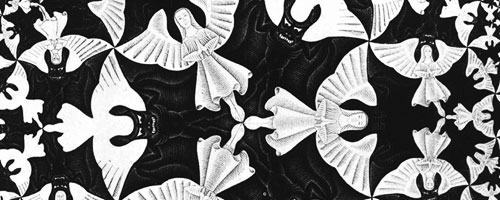
National identity and perspective can influence ones idea of evil, but in reality, the line between good and evil is very permeable. Just like the picture below, where one can see angels, one can also see demons. Stanford psychologist Philip Zimbardo has done much research in his career and is renowned for his insight into the human condition and what makes good people go bad. He argues that people are not innately bad, but are rather put into positions of power that enable conditions of evil to grow. The videos below provide examples of two occurrences that involved American citizens. The first video pertains to Abu Ghraib, in which American troops brutally mutilated and tortured several Middle Eastern prisoners they had at the time. Additionally, the first and the second video cover the true story of the Stanford Prison Experiment, which a young Philip Zimbardo oversaw himself. The external sources I have linked don't seek to excuse, but rather to understand.

7 Social Processes That Grease the Slippery Slope of Evil (Zimbardo)

1. Mindlessly Taking the First Small Step
2. Dehumanization of Others
3. De-individuation of Self (anonymity)
4. Diffusion of Personal Responsibility
5. Blind Obedience to Authority
6. Uncritical Conformity to Group Norms
7. Passive Tolerance of Evil Through Inaction, or Indifference


https://www.youtube.com/watch?v=OsFEV35tWsg&t=548s (Please watch at your own advisory, there are several very disturbing images including graphic violence and partial nudity so be aware!)

https://www.youtube.com/watch?v=3XN2X72jrFk

Tuesday, March 19, 2019

Art in Concentration Camps

In our class discussion about the Holocaust, we briefly touched on the artwork made by prisoners in concentration camps. Despite the creation of art being restricted and having next to no access to art supplies, victims of the holocaust often made artistic pieces with whatever materials they could find (such as toilet paper or scraps of food), then hid them to avoid the severe punishment that it could bring.  The artists risked their lives to depict and memorialize the intense hardships and fights for survival.

The majority of works were directly related to life at the concentration camps. Franciszek Jaźwiecki was a Polish prisoner at Auschwitz. During his imprisonment, he made forbidden portraits of fellow prisoners. He placed special emphasis on the face and facial expressions, in contrast to the subject’s shirts, which were fairly unadorned. On the shirts, Jaźwiecki was careful to include the number and badge of the inmate, possibly so that the portrait could be matched with a name later on. Agnieszka Sieradzka, a curator at the Auschwitz-Birkenau Museum where the works are held, feels as though Jaźwiecki knew that the works would be important historically later on and sought to depict the pain he saw in the eyes of other prisoners.


Because this type of art was restricted, Jaźwiecki hid the pieces in his bed and in his clothing


Sometimes art could be found inscribed on the walls of the camps themselves. This type of art was often created by child and adult prisoners alike.


This particular example comes from the ceiling of a particularly brutal barrack in Birkenau, tasked with digging a canal known as Königsgraben. It housed political prisoners and those who were suspected of plotting revolts. Because of this, these prisoners were kept away from other blocks in addition to being given less food and stricter punishments.

In some cases, prisoners made or kept stencils, and used them to create a variety of designs around barracks.

This design was made by a stencil on a wall of block 14 in Auschwitz. The same stenciling can be seen in numerous locations around the block in different arrangements.

Sometimes, a particular prisoner would be forced by SS officers to create art either for administrative purposes, in the form of models or maps, or personal purposes for the SS officer, such as greeting cards that the officer would then send to family or friends.

Meticulous records were kept by Nazis during the holocaust, which is why we have such a sheer volume of historical information about prisoners, administrative functions, and deaths. By parsing these records, we can know the reason a prisoner was admitted, their basic description, their location, etc. Because of brave artists such as Jaźwiecki, or those who drew on the walls of their barracks, we can catch a glimpse of the pain and toil they experienced. Even when every day was a fight for survival, and the prisoners were stripped of their freedom, they still had the drive to preserve and document the atrocities that they endured in a far more human way than the documents we reviewed in class.


Boyette, Chris. “Auschwitz's Forbidden Art.” CNN, Cable News Network, 26 Jan. 2015, www.cnn.com/2015/01/23/world/art-auschwitz/index.html.

www.auschwitz.org. “AUSCHWITZ-BIRKENAU.” Polski, auschwitz.org/en/museum/historical-collection/works-of-art/.

“Inmate Art from Auschwitz and Birkenau.” Gallery - Inmate Art - Photos, USF, fcit.usf.edu/holocaust/resource/gallery/FWALL.htm.

Monday, March 18, 2019

Ten Stages of Genocide Around the World


When you hear the word genocide, what do you think about?

When most people think about genocide, the first situation that they remember is the Holocaust unless another genocide applies to them or their family. Genocides have happened all around the world, yet many genocides and the steps that led to them are not spoken about often. 

The Ten Stages of Genocide

  1. Classification: People become divided.
  2. Symbolization: People are forced to identify themselves.
  3. Discrimination: People begin to face systematic discrimination. 
  4. Dehumanization: People equated with animals, vermin, or diseases. 
  5. Organization: The government creates specific groups to enforce the policies.
  6. Polarization: The government broadcasts propaganda to turn the populace against the group.
  7. Preparation: Official action to remove / relocate people.
  8. Persecution: Beginning of murders, theft of property, trial massacres. 
  9. Extermination: Wholesale elimination of the group. This is not considered murdered because the people are not considered human. 
  10. Denial: The government denies that it has committed any crime. 

The Cambodian Genocide

Although the Cambodian Genocide can be linked to the 1970s, the decade leading up to it was filled with warning signs regarding the destructive politics that were happening. Khmer Rouge, a group headed by Pol Pot, led the Communist Part of Kampuchea starting in the 1960s and led a military coup in 1970 to become the better political leader. Khmer Rouge believed and sold the idea of an "us versus them" mentality, even causing a civil war between the right-leaning military and those supporting the alliance of Prince Norodom. 
ERVL5381709
Cambodians trying to avoid the rockets launched by the Khmer Rouge Army.
In 1975, Khmer Rouge rose to full power after invading and taking control over the main city. Rouge designated labor camps for farmers to produce food, but ultimately the camps led to starvation, disease, or damage to their bodies. This falls under preparation and discrimination by forcing the farmers to do these jobs. Pol Pot ordered the execution of anyone it had deemed enemies of the state, intellectuals, or potential leaders of a revolutionary movement. Intellectuals were deemed to be those who wore glasses or could speak a foreign language. These decisions exemplify the extermination of those unworthy to live under his rule. There is also a film that illuminates the genocide and brings a deeper understanding to the genocide and the lead up, The Killing Fields. If you want to learn more about the film please look at the following website.

The Armenian Genocide

The Armenian Genocide has also been referred to as the Armenian Holocaust and occurred from 1915 to 1923 with the Ottoman government as the persecutors. Within 3 years one million of the Armenian population had perished at the hands of the government and hundreds of thousands were forced to become homeless and stateless refugees - similar to the Jews during the Holocaust. By 1923, almost the entirety of the Armenian population had been murdered. There were deportations sanctioned by the government that were said to be "a resettlement program," when in reality it was to eliminate the population quietly and under the radar - similar to Adolf Hitler's camps. Looking at the Armenian Genocide and the Holocaust it becomes clear that the two leaders had similar takes on how to accomplish a large scale genocide - which may be the reason that both were successful in removing and murdering most of the intended populations. Armenian soldiers in the Ottoman forces were disarmed and were typically worked to death or outright murdered. Since this genocide aimed to remove Armenians, they were able to separate them from others, relocate them, create propaganda against them, and continuously murder and "eliminate them". The Turkish government refuses to admit that the Armenian Genocide was a genocide at all, instead they call it an "incident". 

In Conclusion... 

Now, with great respect to those who fought and endured these genocides, it is easy to see with clear hindsight how these atrocities occurred and the stages that were obviously leading to something larger. It is important that when we remember these situations to remember that the situations are more dire when you are in them and can feel more like the truth when you're being persecuted. Could the Jews and the Armenians have taken over small amounts of soldiers? Absolutely, but they didn't have the support or mental understanding to know what they were being told was wrong. So, in conclusion, many genocides including ones not mentioned, such as the Bosnian Genocide, have occurred and every perspective should be reviewed during these times. Also, in hindsight it is easy to see the ten stages present themselves prior or during all of these atrocities. If you find the time, look through the websites and become more aware of what has happened around the world!

Please be aware, the websites used to formulate this post are hyperlinked to the sections they provided information for!

By: Veronica Levinson